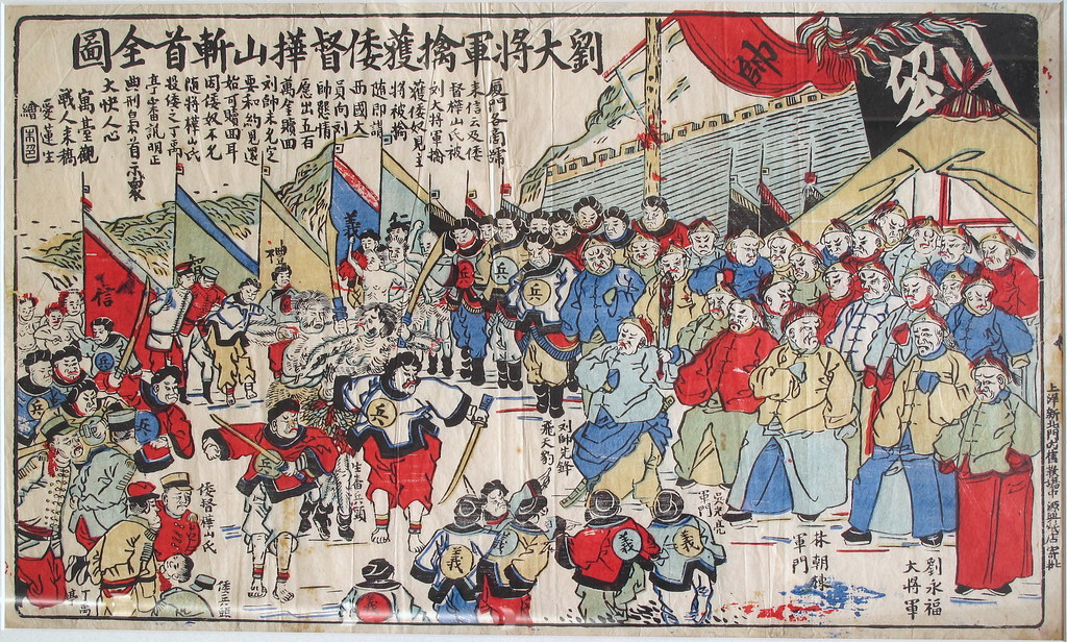
Another completely fictitious image from the aftermath of the Sino-Japanese War of 1894, titled: “Liu Yongfu’s Forces Capture and Execute Kabayama Sukenori”.
As part of the war settlement, China was forced to hand Taiwan over to Japan in 1895. Resistance to the Japanese occupation of Taiwan was headed up by Liu Yongfu, a former guerrilla leader from Guangxi who, along with his Black Flag army, had fought for China against the French occupation of northern Vietnam a decade earlier. He had since been made a minor official and had served in Guangdong province before being sent to Taiwan.
Surrounded by his generals and below a black banner reading “Liu”, Liu Yongfu sits front right wearing a yellow jacket. Japanese prisoners – including Sukenori in red and a man having his head cut off – are huddled together in the lower left corner. A group of hairy, half-naked Taiwanese aborigines, who have been helping the Chinese, wave their broadswords in the air.
The text reads: "Letters received from Xiamen merchants announce the capture of Admiral Kabayama by General Liu. The Japanese begged vehemently that their commander be released, and offered through some foreigners to pay a ransom of five million gold pieces. General Liu would not grant their petition without the assurance that Taiwan would be restored to Chinese control. This the Japanese refused to consider, and the prisoners were therefore subjected, before Tang Wuting, to torture and, in accordance with the law, were decapitated and their heads exhibited in public to the great delight of the people."
But, as mentioned above, this is all fiction. Liu lost the campaign and Sukenori survived, his head firmly attached, to become Taiwan’s first Japanese governor. Liu later wrote his memoirs and outlasted the Qing empire itself, dying in 1917.
Part of the main text says the picture was designed by Ai Liansheng. The text outside the lower right margin locates the print workshop inside the north gate of the old Chinese city of Shanghai, whose name was "上洋".
These types of picture – showing government forces overwhelming the enemy – were known as "Victory Prints", and date back at least to the 1860s, at the end of the Taiping Rebellion. Their popularity gave the British entrepreneur Ernst Major the idea of launching the Chinese-language Dianshizhai Pictorial in 1884, China's first illustrated journal.
A copy of this print appears in "The Island of Formosa, Past and Present" by James Davidson, 1903.
Bought in the UK, 2015.